
How to Search Cases by Name
Start every name search with the right Fayette County court. The Fayette County Circuit and General Sessions services page lists the Circuit Court Clerk's duties. Those duties cover tickets, warrants, judgments, and protection orders. Chancery work follows a different track. Probate belongs to the Fayette County Clerk and Master. So do estates, divorce, adoption, guardianship, name changes, equity, workers' compensation, and delinquent-tax files. A municipal citation stays with its city clerk. The elected County Clerk keeps other county records and is not the trial-court docket keeper.
Read the paper before you call. A warrant, indictment, or General Sessions notice usually points to the Circuit Court Clerk's records. A probate caption points there too. So does an estate filing, divorce paper, or Chancery notice. A ticket bearing a Fayette County city court name belongs to that municipal clerk. The exception is a transfer or appeal. Juvenile material travels its own restricted route. These lines matter because each Fayette County office searches only the records in its custody.
When only a name is known, give the clerk a useful date range. Fayette County offers no online trial form that filters by party and year. Those same facts still help staff separate similar names. Add the other party, decedent, or alleged offense when you know it. Ask for the Fayette County court and case number first. That identifier then drives any request for a setting or a document. Keep the request narrow and factual. A broad ask can be mistaken for a request to build a new report.
With no public trial-case form, ask the right Fayette County clerk to check its index. Give the name as filed. Add enough detail to pin down the matter.
- Read the Fayette County court name on the citation, summons, notice, petition, or judgment.
- Give the Fayette County clerk the full party name, including prior spellings if relevant.
- Add the filing year, case type, and the other party's name when known.
- Ask for the Fayette County case number, current status, next setting, or a named document.
- Confirm the result with the Fayette County office that holds the original Fayette County case.
Fayette County Court Comes First
Ed Pulliam's official Circuit Court Clerk profile lists 705 Justice Drive, Somerville, and 901-465-5205. That office handles Circuit and General Sessions matters first. Amy Anderson's Clerk and Master office keeps the separate Chancery file set, at 16755 Highway 64, Suite 210, Somerville, reachable at 901-465-5219.
You can reach either office by phone, at the counter, or by written mail request. Directories list fax and email contacts too. An informal message is not a formal record request. Ask which method the Fayette County office accepts, what facts it needs, and whether inspection or copies are available. The courthouse offers no self-service terminal.
Key point: Fayette County case lookup is a Fayette County court-routing task first and a name or number search second.
How to Search by Case Number
A complete Fayette County case number is the best search key. It avoids mix-ups between people who share a name. Copy it exactly as printed, with any year, letters, hyphens, or leading zeroes. No Fayette County code chart is published, so never guess at a local segment. Use the identifier shown on the filing, number exactly as filed.
A municipal payment code may be a different identifier. Moscow asks for the five-digit citation number at the top right of a ticket. It wants that number for online payment. That number routes a transaction. It does not prove the payment page shows full case history. If a number returns no match, confirm the Fayette County issuing court. Ask whether the file was transferred or appealed. Then try the party name with an approximate year.
Four Fayette Appellate Search Modes
The Tennessee Public Case History C-Track interface accepts four search keys. Case number, case style, party name, or business and organization name all work. A search term is required. Results can lead to appellate status, procedural history, and linked documents. Those appear when available. Appeals are covered when the Fayette County record was filed after September 1, 2006. Documents filed after August 26, 2013 may be linked to events. Data runs through the prior business day.
| Field | Type | Required | Use |
|---|---|---|---|
| Case Number | Choice and text | Search term | Use an appellate sequence or full appeal number. |
| Case Style | Choice and text | Search term | Enter a distinct part of the caption. |
| Party Name | Choice and text | Search term | Use a first or last name. |
| Business/Organization | Choice and text | Search term | Use an entity that is a party. |
The AOC description covers three courts only. It searches the Supreme Court, Court of Appeals, and Court of Criminal Appeals, not county trial courts.
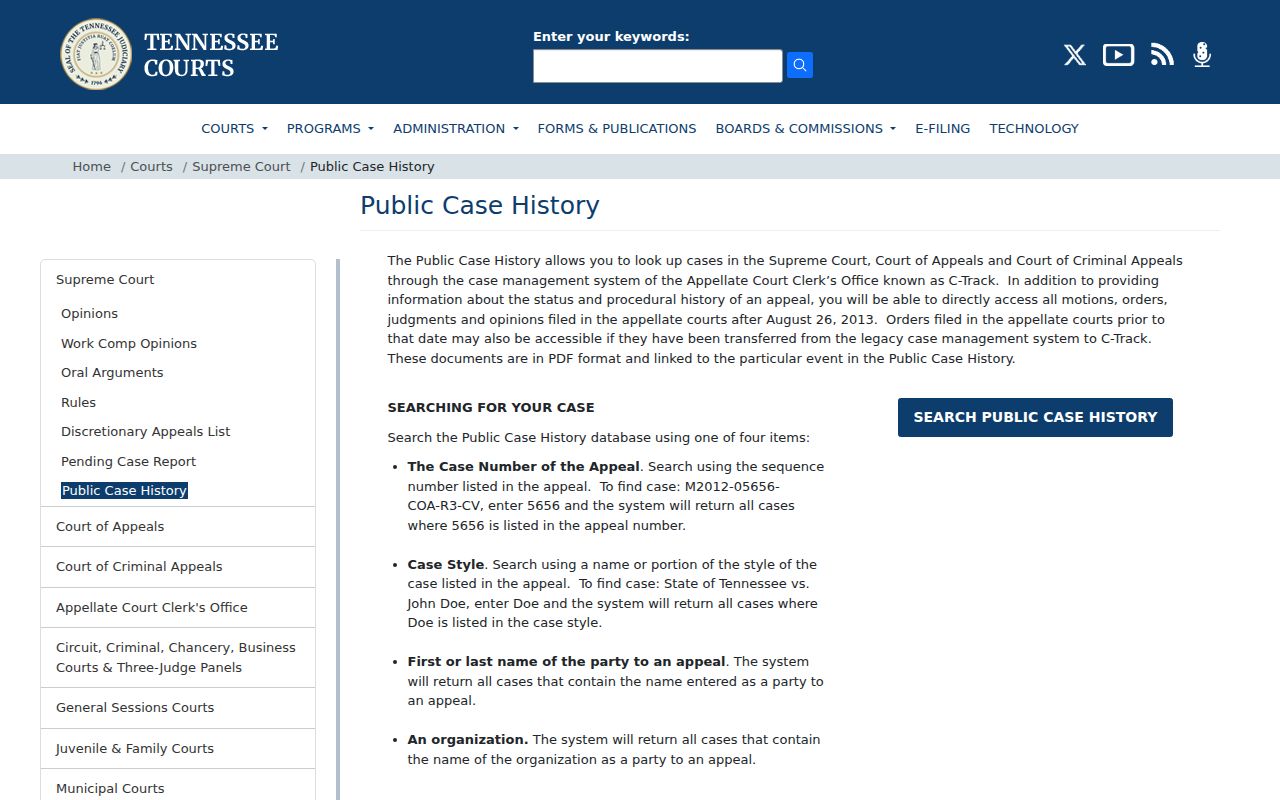
C-Track helps only after a Fayette County case becomes an appeal, which makes it a second layer rather than a starting point.
What a Fayette County case Search Shows
A solid Fayette County result gives you the court, the case number, the style or parties, the filing date, the type, and the procedural status. Docket entries can include a complaint, petition, service return, motion, order, notice, setting, continuance, plea, judgment, disposition, cost entry, payment, appeal, or satisfaction. Read them carefully. A setting is only a scheduled step. A disposition, by contrast, records an outcome.
| Court and number | The custodian and exact identifier for later requests. |
|---|---|
| Style or parties | The caption used to distinguish the Fayette County case. |
| Filed date | When the matter entered that Fayette County court. |
| Status | An open, pending, disposed, or appealed label needing its latest entry for context. |
| Docket events | Dated filings, settings, orders, and disposition activity. |
| Linked documents | Available on some appeals, but no Fayette trial image viewer was found. |
Fayette Results Are Not Documents
That docket line you found is only an index. It tells you a filing exists in the Fayette County file. It is not the motion, order, judgment, or transcript. Ask the clerk who holds the case for the actual paper. State fee material effective in 2026 puts copies at $0.50 per page. Certification and seal cost $5. The Fayette County office can confirm postage, estimates, and the request form.
Do you even need a certified copy? A plain inspection often settles a simple question, and a plain copy reproduces the file. Formal use calls for the clerk's attestation and seal instead. Transcripts and official recordings may sit with the court reporter rather than the clerk. So ask first. More request routes are laid out in the Fayette County Court Record Search.
County vs Statewide Case Search
Local and statewide searches serve different jobs. A Fayette County trial matter belongs with the county's own docket search, while C-Track comes into play only after an appeal is filed. The Tennessee Court of Appeals takes civil appeals. The Fayette County court of Criminal Appeals handles the criminal side.
| Point | Fayette clerk search | C-Track |
|---|---|---|
| Coverage | Circuit, General Sessions, or Chancery | State appellate courts only |
| Method | Phone, counter, mail, and accepted request channels | Public online search |
| Best key | Local number, name, court, and year | Appeal number, style, party, or entity |
| Documents | Ask the custodian for inspection or copies | Some event documents are linked |
| Timing | Confirm current status with the Fayette County clerk | Through the prior business day |
Why Fayette Trial Numbers Fail
Searching a trial case number in C-Track and getting nothing? That is expected. The portal does not function as a statewide trial docket, so a Circuit, General Sessions, Chancery, Juvenile, or municipal number may simply be out of its scope. The miss does not mean your Fayette County case does not exist. A trial case gains its appellate identity only after an appeal is filed and processed. That is when the higher court picks it up.
The official Trial Judge Case Statistics system works differently. It has no party-name search at all. Instead it reports by fiscal year, district, and judge, drawing on clerk reports with quarterly updates.
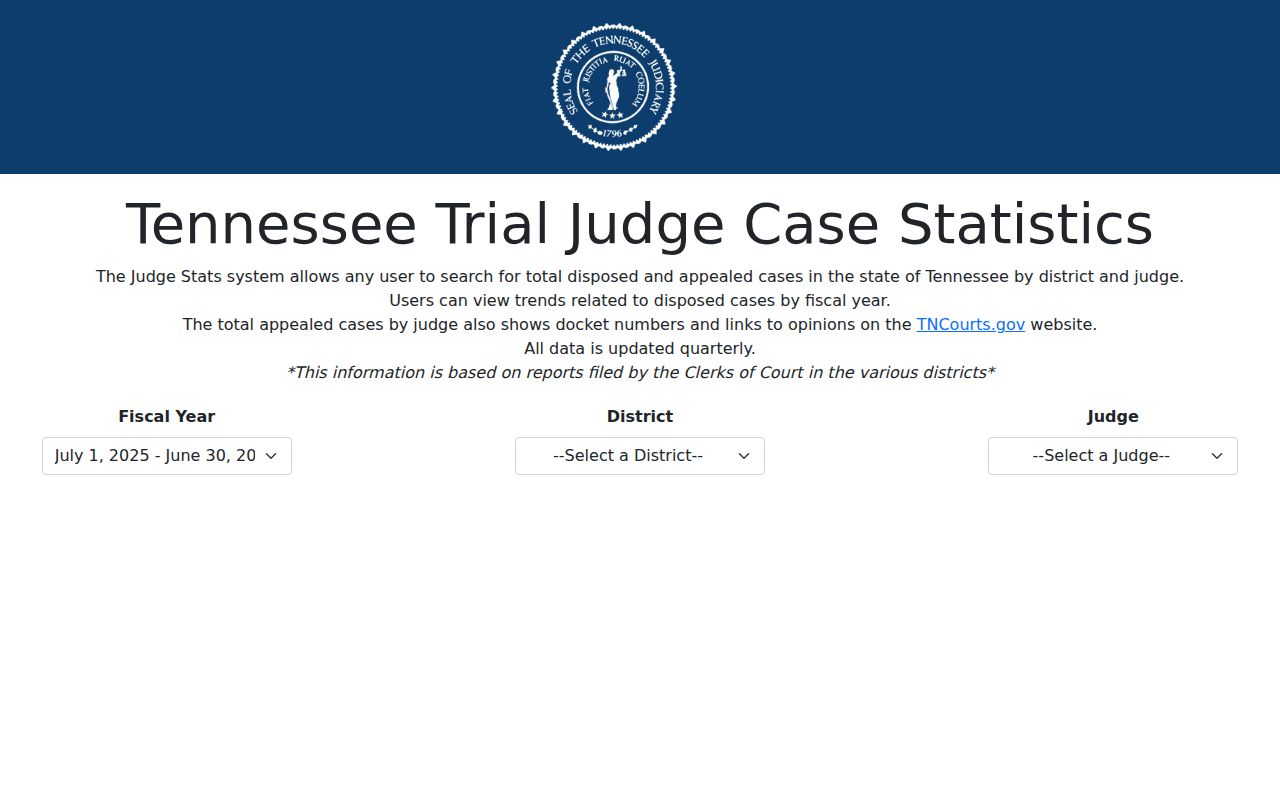
Those controls run a reporting tool, so a single Fayette County trial file still starts with the local clerks.
Restricted Cases and Access Rules
Access rules come chiefly from Tennessee Supreme Court Rule 34. A docket can be public. Parts of the court record may still be sealed, redacted, or confidential. Juvenile records are restricted. Adoption files get added protection. An expunged matter may not show up as an ordinary public result. Even in an open file, sensitive personal data can be removed.
An empty result deserves one more careful pass. Check the spelling, the court, the year, and the case number. Then consider whether the matter is new, transferred, filed under an older number, or closed off by an access limit.
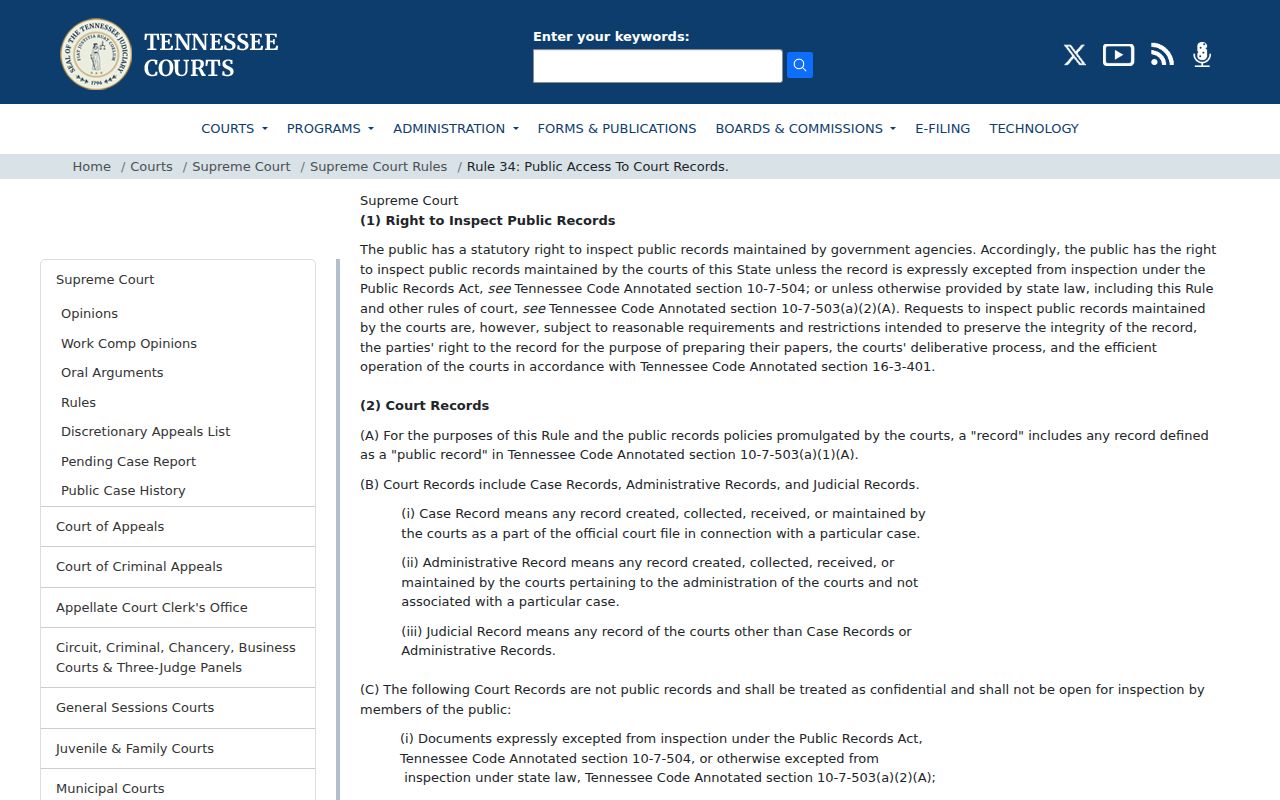
The capture ties Fayette County access decisions to the state judiciary's court-record framework.
Fayette County Empty-Result Checks
Older records can demand a different route. Fayette County's 1925 courthouse fire destroyed some volumes. Ask where the surviving books, scans, and microfilm now live. The Fayette County Library History Room offers ScanPro microfilm access for historical research, but it does not certify active court files.
Work the checks in order. Confirm the right Fayette County court. Match the case number to the source document, then try the full name with an approximate year. Ask about an appeal or transfer, then ask about archive or restricted status. That keeps a Fayette County case lookup pointed at the office that truly holds the record.
Note: A payment receipt, a calendar event, or a statistical report never substitutes for the Fayette County clerk's current case docket.