
Searching Fayette County Criminal Dockets
The clerk's office is the working route. Call Fayette County Circuit Court Clerk Ed Pulliam at 901-465-5205, or go to 705 Justice Drive, Somerville. Mail works too: P.O. Box 670, Somerville, TN 38068. Confirm fees and payment with the office first. Ask whether email or fax counts, since assuming it does may leave a request unstarted.
- Identify Circuit, Fayette County General Sessions, Juvenile, municipal, or appellate court from the paper.
- Give the case, citation, or warrant number; otherwise provide the name as printed, offense, court, and year range.
- Ask for the current setting and the Fayette County criminal docket entry separately.
- Name any document needed, such as indictment, plea, judgment, sentence, or disposition.
- Ask whether the record is public and whether inspection, plain copy, or certified copy is available.
City ordinance and municipal traffic charges live with that city's own clerk instead. Older Fayette County criminal files may survive only on paper, in a bound index, or on microfilm.
Fayette County Criminal Routing
The charge and its stage set the route. General Sessions records can carry warrants, bond events, misdemeanor proceedings, and the preliminary hearing. A felony then moves to Circuit after bind-over or indictment, often with a new number. Juvenile delinquency runs through a restricted court. Municipal dockets cover city matters, not every state-law offense.
| Court | Criminal docket role | Custodian |
|---|---|---|
| Fayette County Circuit Court | Indictments, pleas, trials, judgments, sentences, probation and later events | Ed Pulliam, Fayette County Circuit Court Clerk |
| Fayette County General Sessions | Warrants, misdemeanors, preliminary hearings, bonds and assigned traffic | Fayette County Circuit Court Clerk Ed Pulliam's office |
| Juvenile Court | Youth delinquency and related protected proceedings | Juvenile office, access restricted |
| Municipal court | City ordinance and city traffic charges | Issuing city's clerk |
| Appellate court | Appeal events, briefs, orders and opinions | C-Track Public Case History |
Inside a Fayette County Criminal Docket
Think of the Fayette County docket as a chronological index rather than the whole file. Police reports, evidence, and transcripts live elsewhere. Read each count and event in order. A bond condition listed there may be stale, a hearing date may have been reset, and a plea entry can appear before the written judgment does.
| Header | Court, Fayette County case number, filing date, judge, status, and caption naming the State or city. |
|---|---|
| Charge block | Offense description, count, statute or classification when recorded. |
| Appearance block | Arraignment, preliminary hearing, pretrial, motion, plea, trial, or sentencing settings. |
| Bond block | Amount, type, conditions, release, capias, or forfeiture when publicly recorded. |
| Outcome | Plea, verdict, dismissal, nolle prosequi, diversion, sentence, or transfer. |
| Post-judgment | Probation review or violation, amended sentence, payment, expunction petition, or appeal. |
A docket line may name an order without showing what the order actually says. When exact wording matters, request the filed document itself from the clerk.
Fayette County Criminal Counts in Context
The Tennessee AOC report covering July 1, 2024 through June 30, 2025 counts 684 criminal counts filed and 597 counts disposed in Fayette County. Those are charges, not unique people, and maybe not even unique cases. Accuracy also depends on monthly clerk reporting.
The same report breaks down dispositions: 222 dismissals or nolle prosequi entries, 56 pretrial or judicial diversions, 25 pleas to lesser charges, 15 trial convictions, and 5 acquittals. Each count carries its own status. The totals alone cannot tell you any person's outcome.
How a Criminal Case Moves
A typical docket sequence is Filing → First appearance or arraignment → Preliminary hearing when applicable → Indictment or bind-over → Pretrial motions → Plea or trial → Disposition → Sentencing → Post-judgment events. Not every case follows each step, and one event may occur in Fayette County General Sessions before a later Circuit file begins.
Start by identifying the charging paper: complaint, warrant, presentment, or indictment. Then keep bond entries apart from charge outcomes. A continued pretrial setting is not a dismissal. A plea may be as charged or to a lesser count. Probation violation is a later event tied to an earlier judgment, and a notice of appeal opens a new docket layer without erasing the trial record.
Fayette County Disposition Language
Fayette County publishes no local display-code guide. So keep the exact wording from the docket and ask the clerk to decode any abbreviation. Common labels include conviction after trial, guilty plea as charged, guilty plea to a lesser charge, acquittal, dismissal, nolle prosequi, diversion, transfer, and probation violation.
- Nolle prosequi
- The prosecution formally declined to continue a charge.
- Diversion
- A conditional path that may defer a final conviction and can have later expunction consequences.
- Bind-over
- A Fayette County General Sessions felony path sent onward for grand-jury or Circuit proceedings.
- Capias
- A writ or order directing custody, often connected to a missed required setting.
- Disposition
- The recorded result of a count or case, which may be explained in a judgment or sentence.
Courts That Hold Criminal Dockets
Fayette County Circuit Court serves as the county's general-jurisdiction felony trial court. General Sessions handles misdemeanors plus preliminary felony hearings. The Circuit Court Clerk is the practical records contact for both. A municipal clerk takes city ordinance and city traffic matters. Juvenile Court stays separate and restricted.
Appealed a trial case? Try Tennessee Public Case History. Search it by appellate number, style, party, or organization. Its data runs through the prior business day. It reaches appellate records filed after September 1, 2006. A C-Track hit confirms an appellate record, not a full trial file. The Fayette County Case Lookup walks through that distinction.
Fayette County Recovery Court Docket
Fayette County Recovery Court operates as a 25th Judicial District program. It sits at the General Sessions level. Judge David Douglas presides, and 901-466-3899 is listed as the program contact. The county directory also lists a General Sessions Drug Court coordinator at 901-465-5210. Program staff can explain the program. They cannot hand you the criminal record; that stays with the clerk.
A review setting, diversion condition, or disposition may sit under the underlying Fayette County criminal case number. Treatment reports, medical details, assessments, and supervision records can stay protected. Even a public docket showing the court event does not change that. Ask the Circuit Court Clerk for whatever docket entry or order is releasable. The county posts no public participant search or specialty calendar.
Sealed Dockets and Public Access
Ordinary adult criminal docket events are usually open unless a statute, rule, seal, protective order, expunction, or redaction policy says otherwise. But a visible event does not unseal a sealed attachment. Social Security numbers, financial accounts, protected addresses, medical material, and victim safety information may be removed from view.
Tennessee Supreme Court Rule 34 describes public and confidential appellate court records. Tenn. Code Ann. § 40-32-101 guidance explains that eligible expunction starts in the Fayette County court where the arrest occurred. Juvenile access is separately limited by Tenn. Code Ann. § 37-1-153.
A docket search that comes back empty has several innocent explanations. The name may be spelled differently. The Circuit number may be new. The case may sit in municipal court, juvenile court, or an archive. Sealing and expunction hide records too. Ask the Fayette County clerk whether a redacted docket or public order can be released. Never assume the case never existed.
Fayette County Copies and Verification
Fees start with the 2026 statewide court-clerk chart. It sets $0.50 per page for an ordinary court document. Certification and seal add $5. A Fayette-specific docket-sheet fee, mailing rule, and turnaround are simply not posted anywhere. So ask the clerk for an itemized estimate and the current payment method. A date question often gets answered faster than a full copy request anyway.
Older dockets need double checking. Ask whether the current electronic record and an older paper or index record both need a look. The Fayette County Library History Room offers microfilm research tools. It cannot certify an active criminal judgment. When your copy arrives, compare the Fayette County court. Check the case number, the date, the count, and the certification language too.
Fayette County General Sessions Scope
Tennessee Rule of Criminal Procedure 1 places Fayette County General Sessions courts inside the state's criminal procedure framework. That limited-jurisdiction docket handles misdemeanors and preliminary felony hearings. A later indictment or bind-over can then create a Fayette County Circuit Court record. The official Rule 1 page carries the state source.
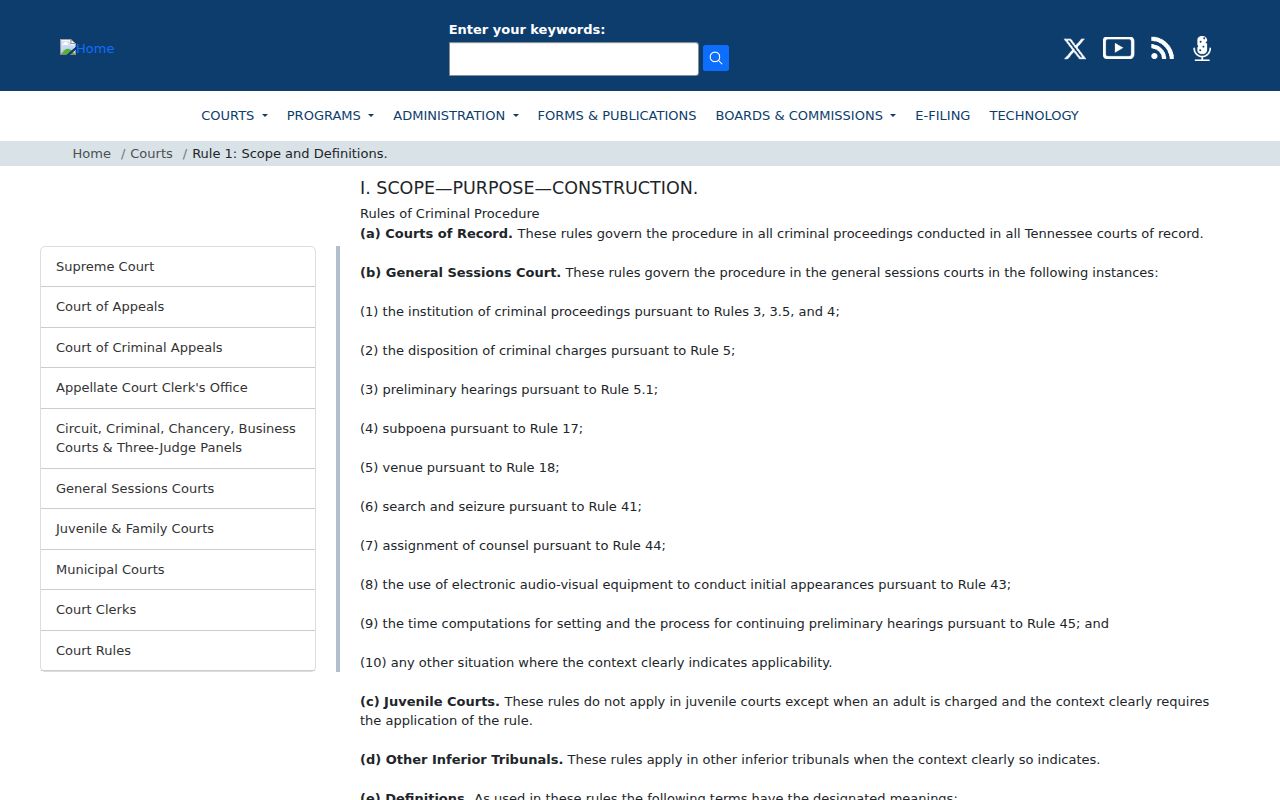
Rule 1 itself gives no Fayette County result, hearing date, or local number format. What it explains is sequence. A misdemeanor or preliminary felony event can land in Fayette County General Sessions. That can happen long before any related Circuit docket exists. When a record spans both courts, have the Fayette County Circuit Court Clerk's office check for a cross-reference. Do not assume the first number carried through unchanged.
Be careful with what each event means. A General Sessions preliminary hearing is not a Circuit trial. A bind-over is not a conviction. An indictment may open the later Circuit sequence. Arraignment, motions, plea or trial, judgment, sentence, and post-judgment events follow it. Request the entry from the stage that answers your actual question. Need a copy? Ask whether the Fayette County clerk can release the charging paper, written order, judgment, or certified disposition. The docket line may come with it.
For a current setting, give both numbers if you have them. Ask which court holds the case now. A matter that reached the Fayette County court of Criminal Appeals works differently. The appellate number belongs in C-Track. The originating criminal docket stays with the local Fayette County clerk.